

Key insights
- Municipal bonds can help support income, diversification, and capital preservation while offering tax advantages that may enhance after-tax returns compared to many taxable fixed income investments.
- Interest rate policy and Treasury yields play a significant role in municipal bond valuations, making it important to understand how changing rate environments can affect both income potential and investment opportunities.
- Municipal bond valuations remain attractive relative to historical norms, providing investors with an opportunity to evaluate tax-efficient income within a broader long-term investment plan.
- Strong credit quality, low default rates, and favorable supply-and-demand dynamics continue to support the municipal bond market and reinforce its role within a diversified portfolio.
Explore tax-advantaged income opportunities.
For investors seeking tax-efficient income, municipal bonds remain a compelling component of a well-diversified portfolio, offering attractive after-tax yield potential, diversification benefits, capital preservation characteristics, and resilience during periods of market volatility.
As expectations for Federal Reserve policy, inflation, and economic growth evolve, investors should closely monitor municipal bond yields and their relative value to assess the attractiveness of current market conditions.
Why municipal bonds are back in focus
Today’s municipal bond market offers some of the most compelling opportunities investors have seen in recent years. Higher yields have increased the income potential available from high-quality municipal issuers while preserving strong credit characteristics.
For investors seeking a combination of income, diversification, and portfolio stability, current market conditions present an attractive opportunity to lock in elevated levels of tax-advantaged income and potentially benefit from future price appreciation if interest rates decline.
How Treasury yields influence municipal bond valuations
Analysis of the municipal bond market begins with the U.S. Treasury market, as Treasury securities establish the benchmark yield against which virtually all US fixed-income assets are valued.
As the risk-free benchmark, Treasury yields provide critical context for assessing municipal bond valuations, relative attractiveness, and the factors influencing market performance.
Interest rate expectations have shifted
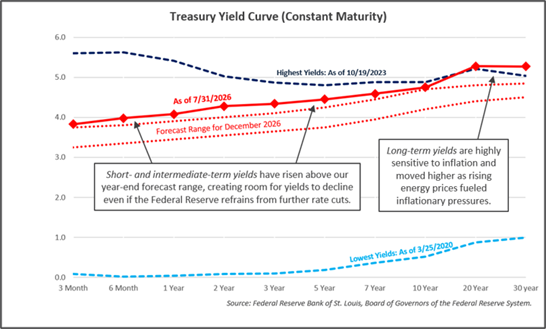
Treasury yields moved higher in early 2026 as escalating tensions in the Middle East and rising energy prices fueled concerns that inflationary pressures could prove more persistent than previously anticipated.
As a result, investors increasingly questioned whether the Federal Reserve would need to tighten monetary policy, contributing to an upward pressure on interest rates.
Yields across the curve rose following a Federal Reserve meeting in July that left policy rates unchanged. The Fed conveyed a more hawkish tone than investors had anticipated, and the Fed’s decision to eliminate forward guidance about monetary policy added uncertainty.
With Treasury rates currently above CLA’s year-end forecast range across the yield curve (shown below), we believe investors have an attractive opportunity to add fixed-income exposure and lock in compelling yield levels.
Why tax-equivalent yield matters
One of the most important considerations when evaluating municipal bonds is their favorable tax treatment. Because municipal bond interest is generally exempt from federal income taxes, investors should convert municipal bond yields into a tax-equivalent yield when comparing them to taxable bond investments. This approach provides a more meaningful assessment of relative value.
For investors in higher tax brackets, a municipal bond with a lower stated yield may generate more after-tax income than a taxable bond with a higher stated yield. As a result, evaluating the tax-equivalent yield can provide a more accurate picture of the income potential associated with different fixed income investments
The value of municipal bonds often extends beyond portfolio income. Discover how coordinated tax and wealth planning can help align investment decisions with broader financial goals. Read the article.
Relative value analysis: Municipal bonds vs. treasuries
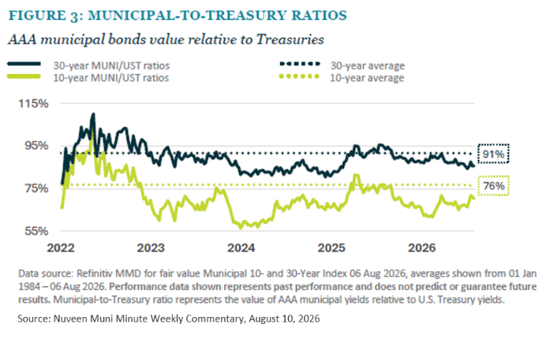
A key methodology for evaluating the municipal bond market is examining the municipal-to-Treasury yield ratio (ratio), which is widely used to assess the relative value of tax-exempt municipal bonds versus risk-free U.S. Treasury securities.
Comparing current ratios to historical averages provides useful context and insight into whether municipal bonds are trading at attractive, fair, or rich valuations.
The most recent 10-year and 30-year municipal-to-Treasury yield ratios were just below their long-term averages, suggesting valuations remain broadly in-line with recent norms.
A complementary methodology evaluates the Municipal-to-Treasury Ratio through a historical scatter plot analysis. By plotting historical observations with the ratio on one axis and the corresponding Treasury yield on the other, investors can assess current valuations relative to historical norms across a range of interest rate environments.
The ratio indicated in the chart below appears attractive compared with historical observations when Treasury yields were at similar levels.
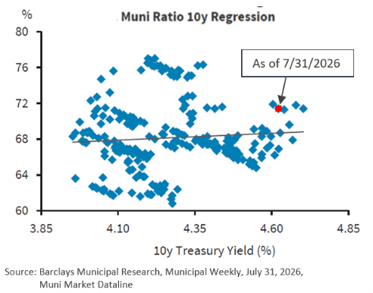
Taken together, these methodologies indicate that municipal bonds remain attractively valued relative to historical norms and Treasury yields, creating a compelling opportunity for investors to earn tax-advantaged income at favorable yield levels.
Strong municipal bond fundamentals and market demand
Credit quality remains healthy
The recent rise in municipal bond yields has occurred despite a fundamentally healthy credit environment. State and local governments generally remain in solid financial condition, supported by stable tax revenues, resilient economic activity, and disciplined fiscal management.
Credit fundamentals across much of the municipal market remain relatively sound, with credit pressures generally concentrated in specific sectors and issuer-level situations rather than indicating broad-based financial deterioration.
Supply and demand trends remain supportive
In addition to strong fundamentals, municipal bonds continue to benefit from favorable market technicals. The asset class is supported by a unique supply-demand dynamic in which investors receive substantial principal repayments and coupon income throughout the year, much of which is reinvested back into the municipal market.
This consistent source of demand helps support valuations, even during periods of elevated issuance. Projected principal redemptions and coupon payments are expected to exceed new issuance in 2026, creating a constructive net supply backdrop.
Combined with continued investor demand, these factors provide an additional tailwind for municipal bonds and reinforce the asset class’s attractive long-term investment case.
What to consider as interest rates move
Whether rates rise, fall, or remain elevated, evaluating municipal bonds through a broader planning lens can help investors make more informed decisions. When evaluating your bond strategy:
- Compare taxable and tax-exempt yields on an after-tax basis
- Review duration exposure before adding or trimming bonds
- Evaluate credit quality by issuer, sector, and revenue source
- Coordinate municipal bond decisions with broader tax, estate, and investment planning
Periods of market volatility can create valuable tax-loss harvesting opportunities, allowing investors to realize losses that may be used to offset current or future capital gains and, in certain cases, reduce taxable ordinary income.
Investors should consult their tax advisor to determine whether tax-loss harvesting is appropriate for their situation and to understand any applicable tax rules.
How CLA can help integrate tax-aware strategies into your investment plan
At CLA, we take the time to understand your specific financial goals, tax considerations, and investment preferences.
Whether you’re looking to enhance tax-efficient income, improve portfolio diversification, or evaluate opportunities within the current municipal bond market, we’ll help tailor your portfolio through a comprehensive range of strategies designed to align with your individual circumstances and objectives