

Key insights
- Review your fees regularly so you can make intentional decisions instead of reacting to budget gaps, sudden increases, or hidden subsidies later on.
- Treat fees as policy choices shaping who pays, who benefits, and how accessible your services are across different segments of your community.
- Use a clear, consistent method to set fees so you can explain how they’re calculated, defend them under scrutiny, and build trust with stakeholders and auditors.
- Start small and follow a practical process to bring more clarity, consistency, and long-term stability to your fee program without needing a full overhaul.
Strengthen public services with smarter government pricing.
Prices and fees shape some of the most visible interactions people have with government — and when they fall out of step with actual costs, policy goals, or service levels, the effects can quickly show up in the form of budget shortfalls, operational instability, and public distrust.
A more disciplined approach to fee setting can help leaders make clearer choices about who pays, what services cost, and how those decisions support long-term service delivery.
How can stronger fee management support your government?
Fees communicate value, influence behavior, and reflect core governance choices about what people can expect and how charges are explained, whether it’s a permit fee, a utility rate, or a recreation program price.
A stronger approach to fees can support your government entity in several practical ways.
Protect the general fund and strengthen fiscal stewardship
User fees exist for a simple reason: Some services provide a “special benefit” to an identifiable user, beyond what the general public receives. In those cases, a fee can be an appropriate funding mechanism because it assigns costs to the beneficiaries rather than all taxpayers.
Internal chargeback models allocate the cost of shared internal services to other departments or agencies based on measurable usage. Instead of funding IT, HR, finance, facilities, or fleet entirely through a single central appropriation, chargebacks make the “price” of those services visible, improving budgeting and cost control and reducing hidden cross-subsidies.
The most common outcome of inactive fee management is under-recovery, meaning the general fund (or another program) quietly subsidizes the service. Over time, these hidden subsidies can crowd out core priorities such as public safety, maintenance, or community programs.
Not every fee must always equal full cost. Many governments intentionally subsidize certain services for equity, economic development, or public health reasons. The key is to make those subsidies deliberate, transparent, and budgeted.
Fee clarity is a hallmark of good financial management and helps reduce the risk of “fee shock” when years of increases are ignored and then corrected all at once.
Increase transparency, trust, and defensibility
Fees are often politically sensitive because they’re tangible, immediate, and highly visible. Fee decisions become easier to communicate and harder to mischaracterize when a government can show fees are based on a repeatable method, such as:
- Defining the service
- Measuring workload and volumes
- Identifying direct and indirect costs
- Adopting a policy approach to subsidies
Advance equity and access through intentional design
Fees can either support or undermine equity, depending on how they’re structured. Intentionally reviewing fee schedules can help governments proactively evaluate who pays, who benefits, and whether the fee design aligns with community values.
Common tools include:
- Income-based discounts
- Senior or youth pricing
- Hardship waivers
- Tiered rates based on usage
- Caps on total charges
- Subsidies funded through appropriations
In each case, better fee management improves the government’s ability to target assistance without destabilizing the underlying service.
Improve service performance and manage demand
Prices are signals. Even when government isn’t “selling” services in a traditional sense, fee levels influence how much demand shows up at the counter, how quickly customers submit complete applications, and how much staff time is consumed by rework and follow-up.
When fees are set far below cost with no funding backfill, service quality can suffer, manifesting as longer wait times, a growing backlog of inspections or permits, deferred maintenance, or an inability to invest in online self-service tools.
Well-managed fee structures allow governments to align pricing with service levels and policy objectives. Examples include:
- Expedited service options priced to cover overtime or surge capacity
- Higher charges for complex reviews that consume more staff time
- Creating tiered pricing based on complexity of service delivered
- Lower prices for online transactions that reduce processing costs
Thoughtful pricing can also support behavior goals such as encouraging timely compliance, shifting demand away from peak periods, or promoting resource conservation in utility contexts.
Reduce legal, audit, and oversight risk
Many fees are constrained by statute, ordinance, grant requirements, or case law. Even when the legal framework differs across federal, state, and local government, the operational reality is similar — poor documentation and outdated cost assumptions create exposure.
Fee reviews supported by cost-of-service analysis and clear records can improve audit readiness and help demonstrate compliance with legislation or other requirements.
Oversight bodies often expect agencies to periodically review fees, update them when costs change, and explain persistent over- or under-recovery. By institutionalizing routine fee review discipline, government agencies reduce the likelihood of findings, challenges, or controversy tied to unexplained fee levels.
Support economic development and a better customer experience
For businesses, developers, and nonprofits, fees are part of the cost of doing business with government. Unclear fee schedules, surprise add-ons, and frequent ad-hoc exceptions can create friction and undermine economic development goals.
A clear and stable fee framework — one that is published, easy to navigate, based on quantifiable usage, and tied to service definitions — helps reduce uncertainty and improve compliance.
Fee management also supports modernization. When leaders understand which services are underfunded and why, they can invest in online tools and automation to help lower unit costs while improving turnaround times and end-user satisfaction.
Sustain internal services and shared-service models
Fee discipline matters not only for external customers but also for internal prices charged to departments such as IT service rates, fleet charges, facilities maintenance, or payroll processing.
In shared-service environments, rates that don’t reflect full cost can create structural deficits, defer technology refresh, and cause sudden, disruptive rate spikes later.
Well-structured internal pricing can improve transparency across departments, enable better budgeting, and help leadership compare alternatives.
Improve revenue integrity and reduce leakage
Even when fee levels are “right,” many governments lose revenue through inconsistent application of fees, excessive manual adjustments, undocumented waivers, incomplete billing, or weak collections processes.
A focus on fees naturally drives improvements in revenue integrity by clarifying rules, standardizing how fees are calculated, simplifying schedules, improving point-of-sale and permitting system configuration, and monitoring exceptions.
These steps help reduce both financial leakage and reputational risk by treating customers consistently.
A practical roadmap for getting fees under control
Improving fee management doesn’t require a wholesale overhaul. The steps below provide a practical sequence leadership teams can use to move from one-time fixes to an easier and more reliable fee program.
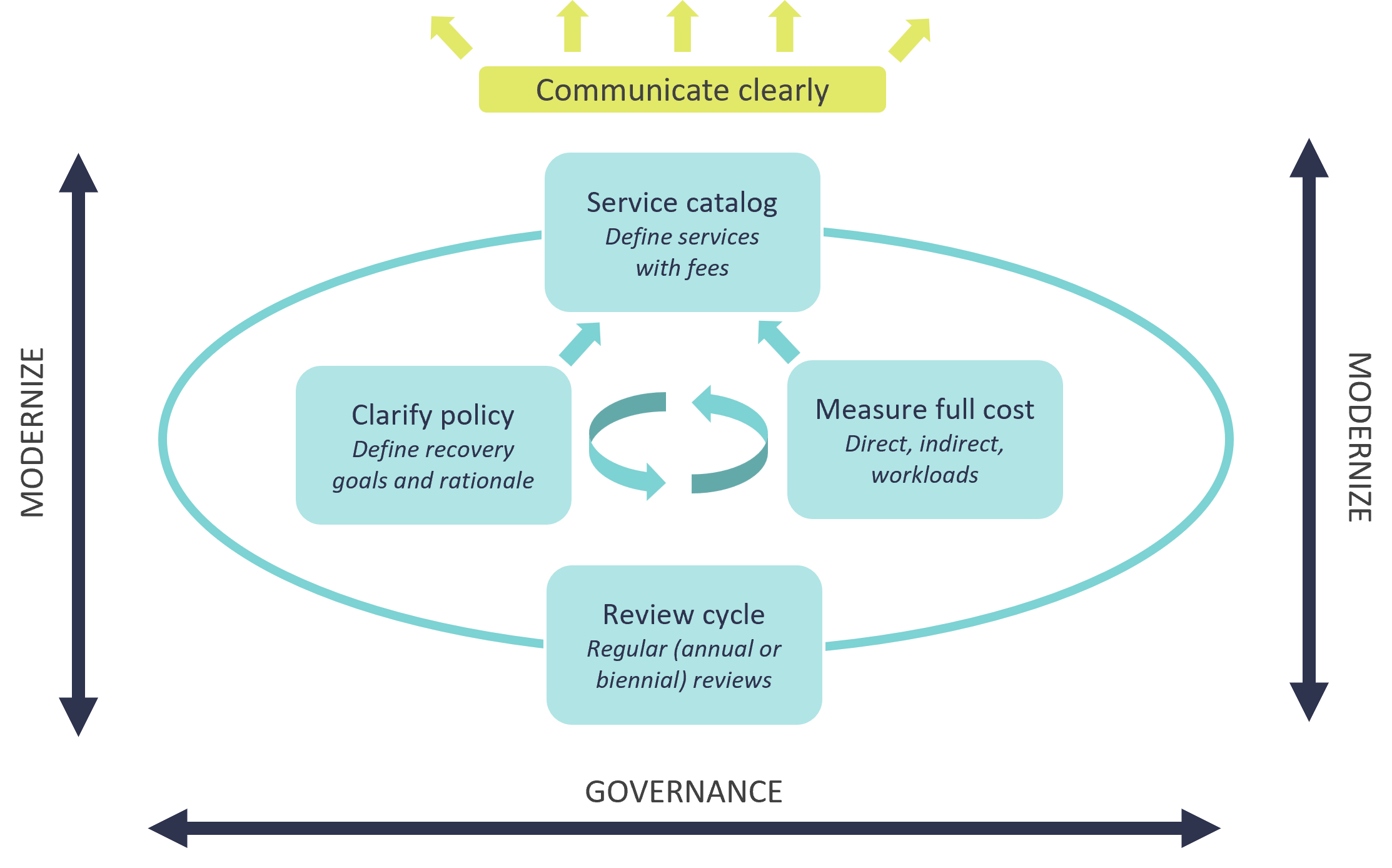
-
Inventory and simplify
Build a complete catalog of fees (external and internal), eliminate duplicates, and define the service behind each charge.
-
Clarify the policy
Establish whether each fee is intended for full cost recovery, partial subsidy, market alignment, or behavior change, and document the rationale.
-
Measure full cost
Identify direct labor and non-labor inputs, allocate indirect costs systematically, and validate volumes and workload assumptions.
-
Set governance
Establish who owns fee updates, what approval path is required, and what documentation must accompany proposals.
Define shared ownership across finance, departments, and leadership, with clear approval paths and documentation expectations.
-
Adopt a review cycle
Use regular (e.g., annual or biennial) reviews to update costs, track under/over-recovery, and avoid sudden corrections.
Review with periodic deeper cost-of-service updates (e.g., every 3 – 5 years) or when conditions change.
-
Communicate clearly
Publish plain-language fee schedules, explain what customers receive, and provide advance notice and rationale for changes.
-
Modernize the transaction
Configure systems to calculate fees consistently, capture data for reporting, and reduce manual adjustments.
-
Add independent perspective
Engage external reviewers to validate methods, benchmark results, and reinforce consistency across departments.
In an environment of rising costs and heightened expectations, disciplined fee management is one of the more practical ways governments can deliver sustainable services while honoring the public trust.
Government fees are not merely administrative details, they’re policy instruments and financial lifelines that shape service quality, fairness, and public confidence.
How CLA can help with government pricing strategies
CLA works with government entities to assess fee structures, conduct cost-of-service analyses, and support pricing decisions with clear governance, documentation, and financial insight.
We bring an objective perspective to help you work through sensitive fee discussions and provide independent analysis that separates technical rate calculations from policy decisions.
Our team can help you evaluate cost recovery, identify hidden subsidies or revenue leakage, and build a more consistent approach to fee review and updates.
With a background in audit, we also help document methodologies and decisions in a way that supports defensibility and reduces the risk of challenges or findings — while strengthening fiscal stewardship, communication, and alignment with community priorities.
Contact us
Strengthen public services with smarter government pricing. Complete the form below to connect with CLA.