

Key insights
- You don’t need perfect certainty to make big decisions — a financial model helps you see how different assumptions could play out before you commit people, capital, or time.
- The real value of a financial model is connecting everyday operational choices (volume, staffing, pricing, timing) to what they mean for cash, margins, and debt capacity down the road.
- Good models don’t just project a single future — they let you test “what if” scenarios in real time so you can respond earlier, or decide not to move forward at all.
- In health care and senior living, where small shifts can have big ripple effects, modeling brings clarity to risk, affordability, and timing — and helps teams rally around clearer go/no‑go calls.
Model financial outcomes before making high stakes decisions.
What health care situations call for a good financial model?
Example situation #1
You’re a hospital with financial pressures and demographic shifts on the horizon. You’ve done the work. Your strategic planning process, anchored by industry analysis and validated surveys, has landed on several options for financial sustainability.
One of the lynchpins to your growth strategy is an expanded orthopedic service line, including another surgeon. Leadership believes the expansion should be accretive; however, payer mix shifts, ramp-up timing, and surgeon productivity assumptions make the financial outcome far from certain.
Example situation #2
You’re a life plan community. You know there is a surging need for senior housing and care.
You’ve used market and demographic analyses to pinpoint where and how you want to expand. First, new independent living units followed with a second phase for additional assisted living and memory care capacity.
How many units can your debt capacity support, and what’s the best timeline for each phase?
Why develop a financial model for your health care organization?
A financial model can help answer the questions posed by these situations.
A model connects operational drivers, such as volumes, pricing, or capital spend with financial outcomes such as operating margin, cash flow, or debt covenant performance. It then becomes a strategic tool allowing decision makers to understand how changes impact future financial performance.
More than a forecast, a financial model creates a structured way to test assumptions before capital, people, and time are committed.
“CLA Intuition® helps leaders move past directional thinking and understand the financial consequences of their decisions before they make them,” said CLA Intuition leader Tom Hammond.
Basics of financial modeling
When we work with health care and life sciences (HCLS) clients, there are four basic elements in our financial modeling process:
1. Clarify the decisions that matter most and identify key business drivers (Baseline/current state)
A clearly defined purpose for the model helps identify the most relevant drivers. It serves as a current state setting the stage for any strategy discussion.
2. Model impacts of business drivers (Strategic/future state)
The model takes the baseline assumptions and forecasts how shifts in strategy look like as they flow into your revenue, expenses, balance sheet, days cash on hand, debt, and more. This is the engine of the modeling process and provides a future-focused financial outlook.
3. Visualize changes with real-time dashboards (“If-then” scenarios)
A well-developed financial model allows you to visualize the financial outlook of your decisions while providing real-time “if-then” scenario planning and impact analysis.
4. Make informed strategic decisions (Go/no-go)
At the core, financial models are used to evaluate the potential impacts of one or a combination of decisions on both short-term operational needs and long-term strategic goals in mind. Ultimately, the model works to aligns teams around the appropriate path forward — the “go/no-go” decisions.
Importance of financial models for health care and life sciences
Financial modeling is particularly valuable for HCLS organizations since they operate in a heavily regulated, complicated environment where even small changes can have outsized financial impact.
Financial modeling: Future-forward vision
Our article The Coming Decade provides insights on demographic changes, reimbursement and cost pressures, potential Medicaid cuts and the role (and cost) of technology and AI.
We see financial modeling as one strategic tool you can use to help analyze and understand how decisions surrounding these changes can help you cast a financially feasible future-forward vision.
Further, HCLS organizations continue to face a rapidly shifting landscape where early preparation is important. In a volatile environment, the value of a financial model isn’t just accuracy — it’s adaptability.
You’ll be faced with sifting and connecting a myriad of impacts on:
- Volume, capacity, and ramp-up timing (clinics, service lines, beds, units)
- Reimbursement rates and payer mix (including downside impact)
- Workforce impacts and assumptions (staffing levels, wage inflation, agency use, productivity)
- Supply and overhead cost inflation
- Capital spend, phasing investments, and financing structure
- Liquidity, debt service coverage, and covenant headroom
The ability to adjust assumptions and immediately see downstream impacts allows leaders to act earlier — or avoid acting too late.
This is where a well-developed financial model like CLA Intuition can bring order to complex, interconnected business drivers while increasing insights into affordability, timing, risk considerations, and so much more.
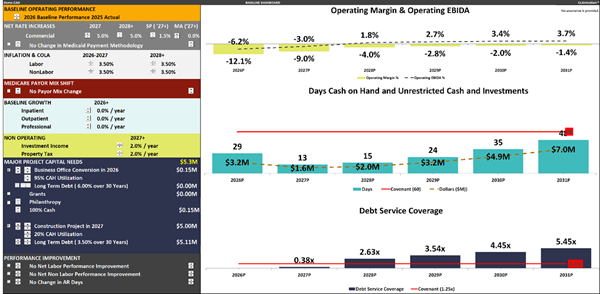
CLA Intuition — Example of a baseline dashboard (critical access hospital)
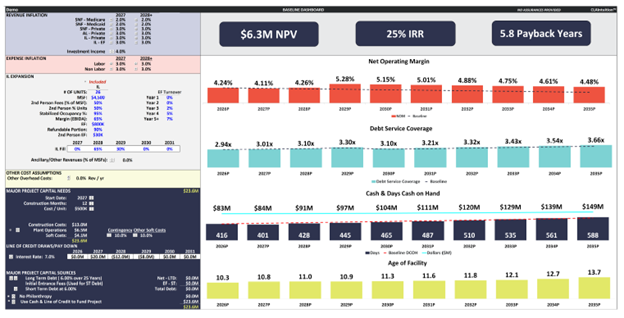
CLA Intuition — Example of a strategic dashboard (senior living/independent living expansion)
How CLA can help with financial modeling
CLA helps HCLS organizations make high-stakes decisions with greater clarity, confidence, and financial discipline in many different situations:
- Evaluating major operational changes (adding service lines or units, shifting site of care, restructuring, or responding to reimbursement and inflation pressures)
- Assessing capital and financing needs (debt capacity, covenant coverage, and capital planning for major projects)
- Building a strategic growth plan (new markets, scaling operations, and working-capital needs)
- Modeling mergers and acquisitions (integration scenarios, pro forma performance, and timing)
Our HCLS industry and financial modeling teams can work with you to craft a CLA Intuition model and plan fitting your specific future needs.