

Key insights
- Strong contribution accounting starts with understanding donor intent, supporting documentation, and when the organization gains the right to donated assets.
- Donor restrictions govern how or when funds are used, while donor conditions must be met before revenue can be recognized.
- Grant agreements deserve careful review because barriers, return provisions, and release clauses can directly affect the timing of revenue recognition.
- Consistent policies for classifying contributions and tracking restricted funds support clearer records, accurate financial statements, and faithful use of donor support.
Review funding terms for clearer revenue recognition.
Clear contribution accounting helps nonprofits recognize revenue at the right time, report donor-restricted funds accurately, and use donor support as intended. The treatment depends on whether funding carries a donor restriction, a donor condition, or another term affecting when and how it may be used.
These restrictions can help advance strategic initiatives, but they also introduce additional accounting and operational considerations. Learn how to classify common contributions, distinguish restrictions from conditions, and apply funding terms more consistently.
Common types of nonprofit contributions
Understanding the nature of contributions is essential because the accounting treatment often depends on the supporting documentation, donor intent, and timing of your organization’s right to the assets.
Donations and pledges
Donations and pledges represent support provided by individuals, corporations, foundations, or other organizations. Contributions may be received immediately or promised for a future date.
Some gifts arrive through donor-advised funds (DAFs), which work like charitable giving accounts held by a sponsoring public charity. Because the sponsor legally controls the funds, it's generally considered the donor, and any restrictions come from the terms of its grant.
From an accounting perspective, the key considerations are the underlying documentation, the timing of the donor's commitment, and whether any donor-imposed restrictions affect the use of the funds.
Contributions and grants have long been the lifeblood of the nonprofit sector. Although unrestricted gifts offer the greatest flexibility, donors often restrict funding to support a specific cause or program.
Grants
Grants are funds awarded by government agencies, private foundations, corporations, or other funding organizations, typically to support specific programs, projects, or initiatives.
Evaluating grant agreements is critical because revenue recognition often depends on whether the grant contains conditions that must be satisfied before the organization is entitled to recognize the revenue.
Bequests
Bequests are contributions received through a donor's will or estate plan and are often an important component of an organization's long-term fundraising strategy. The accounting treatment can vary depending on the terms of the estate documents and when the organization obtains an enforceable right to the assets.
In-kind contributions
Also referred to as contributions of nonfinancial assets, in-kind contributions consist of donated goods, services, facilities, materials, or specialized professional expertise.
Although no cash changes hands, these contributions may represent significant support to an organization and generally require evaluation to determine whether they should be recognized and measured in the financial statements.
Distinguishing between a donor restriction and a condition
One of the most important considerations in contribution accounting is determining whether a donor-imposed stipulation represents a restriction or a condition. While the terms are often used interchangeably in everyday conversation, they have very different accounting implications.
What is a donor restriction?
A donor restriction limits how or when contributed resources may be used by an organization. Restrictions can be based on a specific purpose, the passage of time, or both.
For example, a donor may contribute funds specifically for the construction of a new program facility or require the gift be used in a future period. Once imposed by the donor, these restrictions can’t be altered by the organization.
Contributions subject to donor restrictions are generally recognized as revenue when received or promised, with the restriction reflected in the net asset classification until the restriction is satisfied.
What is a donor condition?
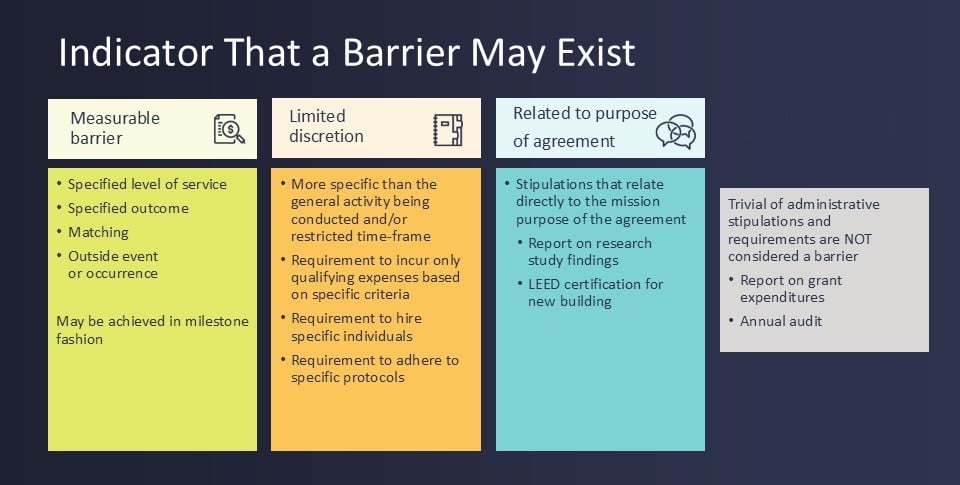
A donor condition requires the organization to overcome a specified barrier before it’s entitled to the transferred assets.
The agreement must include either a right-of-return of the assets to the donor or a right of release from the donor's obligation to transfer the assets. The chart below outlines measurable barriers and other key considerations indicating a barrier may exist.
How CLA can help with donor-restricted contribution accounting
Managing donor restrictions and conditions can strain staff time, complicate revenue recognition, and create reporting risks.
CLA’s nonprofit consulting team can help your organization review contribution and grant agreements, assess the appropriate accounting treatment, and support financial statement preparation and related disclosures. We can also help strengthen policies and processes for tracking restricted funds and documenting donor intent.
This advisory support can give your organization clearer records, more consistent reporting, and practical guidance for applying requirements to new or unusual funding arrangements.
Contact us
Review funding terms for clearer revenue recognition. Complete the form below to connect with CLA.