

Learn how a Sage Intacct assessment can reduce workarounds, improve reporting, and help your system support business growth.
Your Sage Intacct implementation was a success. A few years ago, your team went live smoothly. Your processes were clean. Your reporting was clear. Your stakeholders had the visibility they needed. It was exactly what you hoped for.
But a lot has changed since then.
Perhaps you've acquired another company, expanded into new markets, or launched new product lines. Maybe you've grown from one entity to three. Your finance team of four is now seven. Your reporting needs have evolved. You're doing business in ways you didn't anticipate when you first configured the system.
That's what success looks like. Getting from one entity to three, from a four-person team to seven, while navigating new markets and acquisitions — that takes strategic thinking and disciplined execution.
But your Sage Intacct configuration was built for the company you were, not the company you are now. As you've grown, you've probably noticed it. Month-end close is taking longer. Your team is spending time reclassifying transactions because accounts aren't where they expect them. You're building spreadsheets to get the reports you need. Workarounds grow as it’s hard to keep up with quarterly releases and new functionality.
These aren't problems with Sage Intacct. They're growing pains. And they're fixable.
The question isn't whether your system is broken. It's whether it's configured for where you are today, and ready for where you're going tomorrow.
What happens when your business evolves faster than your Sage Intacct configuration
As your business became more complex — new entities, departments, products, markets — your Sage Intacct configuration didn't automatically evolve with it. Instead, you made tactical decisions to solve immediate problems:
- You added a new dimension for a new business unit
- You created additional account ranges for the acquired company
- You set up new allocations because your overhead structure changed
- You added exceptions to your month-end close process because the standard process no longer fit
Each decision made sense at the time. But they compound. Your dimension structure becomes redundant. Your chart of accounts grows inconsistent. Your month-end close becomes more complex, not simpler. Meanwhile, the software and technology advanced.
The result: A system that works but requires workarounds. A system held together by spreadsheets and manual processes. A system that's not configured for the company you've become and not leveraging the technological advancements of today.
How Sage Intacct assessments can help
Here's what we've learned: Every growing organization's Sage Intacct system goes through this cycle. The companies we work with discover their system doesn't need to be re-implemented. It needs to be assessed and refined. That's a very different project, and it's much less disruptive.An assessment typically focuses on:
Dimension strategy
We help you step back and ask: "What do we actually need to report on?" Then we design a dimension structure eliminating redundancies, supporting your current reporting needs, and scalable for future growth. This might mean consolidating dimensions or enabling features like dimension relationships or cross-approval workflows that you didn't know existed.
Chart of accounts
Sage Intacct now can update GL account numbers and class IDs without re-implementing. This means you can restructure your chart of accounts, consolidate ranges, and clean up your account numbering without losing your historical data or breaking your existing transactions.
Configuration settings and new releases
There are small settings with outsized impact: posting summaries, dimension display, aging settings, default accounts, subledger balances, and core controls. Many organizations have these set to default values but tweaking them can dramatically improve efficiency and accuracy.
Beyond that, Sage releases quarterly updates with new features: AR refunds, GL account updates, a new prepaid functionality core to AP, or a new module like Sage fixed assets management - that could solve your current workarounds. The challenge: It's hard to stay on top of what's new when you're running month-end close and managing growth. We often find organizations using manual processes Sage has since automated, simply because they didn't know the capability existed.
Automation
Platform triggers, dynamic allocations, month-end close automation, integrations, and now AI can eliminate hours of manual work. We help you identify which manual processes could be automated, then help implement them.
How we execute Sage Intacct assessment projects
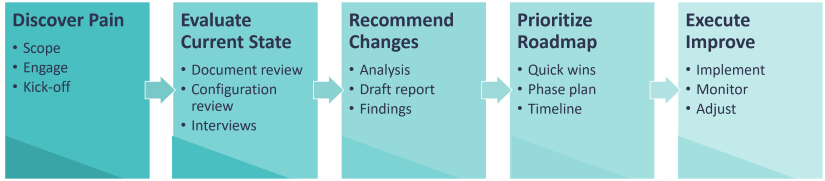
When we assess a Sage Intacct environment for a growing organization, we look at seven key areas:
- Process and reporting requirements review — What do you actually need from the system? What reports matter most? Where are you still using spreadsheets?
- Structure review — Chart of accounts, dimensions, multi-entity structure. Are they still serving your business, or are they creating friction?
- Configuration settings — Are posting summaries, aging, default accounts, and controls set up to support efficiency and accuracy?
- Available Sage Intacct features — What automation, AI, and advanced features could you be using but aren't?
- Subledger review — Accounts Receivable, Accounts Payable, Order Entry. Are they configured effectively for your business?
- Month-end close — Is your close process as efficient as it could be?
- Integrations and tools — What systems connect to Sage Intacct? Are there opportunities to reduce manual data entry?
This assessment typically takes 4-8 weeks, and the output is a prioritized roadmap: quick wins you can implement immediately, medium-term projects, and long-term enhancements.
Lastly, if you already have projects in mind and know exactly where you’d like to go, but need help, we can put together a customized post-implementation project to help you get there.
How CLA can help with Sage Intacct configuration
As your company grows, so should your Sage Intacct system. But meeting that need doesn't mean re-implementing. It means making smart, targeted improvements setting you up for your next chapter.
Ready to find out if your Sage Intacct is positioned for growth? In 30 minutes, we'll assess your environment and map out your next steps — whether that's a full assessment or a targeted project, we’ll help you get there.