

Key insights
- When AI, data, and talent strategies work together, they create a reinforcing cycle that improves capacity, client outcomes, and revenue growth.
- AI helps professional firms work faster and smarter by automating routine tasks and freeing people to focus on higher value client work.
- Better use of data leads to clearer decision making, more accurate forecasting, and stronger financial performance.
- Investing in people — through development, culture, and retention — strengthens client relationships and builds long-term stability.
Strengthen your firm with smarter tools and stronger teams.
Client expectations are shifting, technology is reshaping the way we work, and the pressure to grow (while staying efficient) is heavier than ever. But among all the noise, three priorities keep rising to the top across the professional services industry:
- Making a real plan for AI
- Using data to drive decisions
- Attracting and keeping the right people
On their own, each one is meaningful. Together, they’re the formula for stronger margins, healthier firms, and growth that doesn’t burn out your team.
How AI is helping firms build revenue
Most firms have experimented with AI in one way or another. Maybe it’s helping sift through documents, draft routine communications, support your ticketing systems, or speed up internal processes. The real question isn’t “where can we automate?” but “where does AI support our margin strategy and client experience? But AI has moved past the “pilot” stage, from buzzword to business tool. The firms seeing real results are the ones treating AI like a strategic capability, not a trendy add-on.
Automating tasks that drain time and profit
AI takes on the repetitive, low‑value work eating into margins. This includes time entry prompts, invoice prep, WIP review, project status reporting, and first‑pass document review. When these pieces stop consuming billable talent, firms often see cleaner billing cycles and less non‑billable drag. That reclaimed capacity allows firms to redesign roles around higher‑value advisory and oversight work, supporting different staffing ratios and improved realization without increasing headcount.
Improving accuracy with tools to reduce human error
AI systems can help prevent mistakes while generating clear audit trails and consistent documentation. That matters for firms operating under strict compliance expectations — from legal notes to engineering submittals to IT incident logs. As accuracy becomes more system‑driven, firms can shift experienced professionals away from rework and control tasks and toward judgment‑based roles that increase leverage and client value.
Speeding up turnaround times in ways clients notice
AI shortens response and delivery cycles without cutting corners. That can mean faster matter intake for legal teams, quicker incident resolution for IT providers, or cleaner, more complete submittals for engineering clients. Over time, faster and more predictable delivery enables firms to rebalance teams toward client‑facing advisory work, improving both realization and perceived value while supporting growth without linear staffing increases.
Done right, AI doesn’t replace people — it gives them more breathing room to focus on the work clients value most. And when your teams have more room for higher-level advisory work, your firm naturally opens more revenue opportunity without inflating payroll.
Why service firms should analyze their data
If AI helps you run, data helps you steer. It’s your compass in an unpredictable market.
Most firms have plenty of data lying around — project hours, margins, client trends, hiring costs, realization rates — but not nearly enough firms use it in a meaningful, day-to-day way.
The firms seeing the biggest impact are executives leading their teams to build dashboards, tracking leading indicators (not just historical ones), and empowering people across the firm to use data to make decisions, not just receive reports. Data maturity directly shapes revenue maturity.
Makes pricing and profitability more predictable
Clear data highlights where revenue is earned or lost. Firms can spot scope drift earlier, see which clients or service lines are truly profitable versus simply busy, and intentionally adjust pricing before renewal season.
Gives leaders stronger forecasting and capacity visibility
Role‑specific dashboards show where demand is rising and where teams may stretch thin. Leading indicators — proposal volume, win rates, backlog signals — give firms time to rebalance workloads or add support.
Puts useful information directly in the hands of teams
When people see real‑time budget burn, workload balance, or client trends, they adjust faster. It keeps projects on track and helps reduce end‑of‑month surprises.
What drives talent retention?
Despite all the tech changes happening around us, one thing hasn’t changed: talent is still the heartbeat of every professional firm. Professional firms rise or fall based on the quality, stability, and engagement of their people. Rather than eliminating roles, AI reshapes careers by accelerating movement toward higher‑value work and redefining what experience and readiness look like at each level.
The firms winning today’s talent race are doing a few things very well:
Giving people pathways to grow
Defined roles and expectations shorten ramp‑up time and help people see how they can advance. When your team knows what comes next, they’re more engaged and easier to retain.
Mentoring early and often
Regular feedback and hands‑on guidance reduce rework. It also strengthens confidence, helping newer staff contribute to client work sooner.
Offering flexibility without losing accountability
Balanced schedules and thoughtful coverage models prevent burnout without hurting delivery. Clients get consistency, and teams get room to work in healthier ways.
Making continuous learning the norm, not a checkbox
Ongoing training — technical, industry, leadership, or AI‑related — keeps teams sharp. It helps strengthen client conversations and reinforce trust.
When people feel supported, they stay longer. When people stay longer, clients stay longer. When clients stay longer, revenue becomes more predictable. It’s all connected.
How AI, data analytics, and talent retention work together
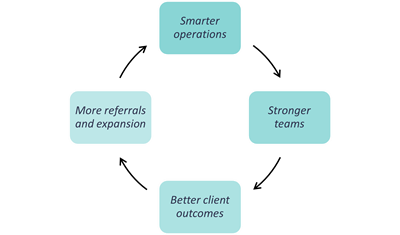
These three priorities aren’t separate initiatives. They reinforce each other and drive growth:
- Leadership alignment, goals and governances align professionals to adopt and use AI
- AI frees your people to do their best work
- Data analytics helps you deploy those people where they have the biggest impact
- Strong talent makes your AI and data investments worth it
The growth loop:
How CLA can help your professional services firm grow
If your firm is thinking about how to put these priorities into practice — and doing it to fit your size, industry, and growth stage — CLA can help by getting to know your firm, your people, and your vision for the next several years.
We work alongside firms in engineering, staffing, IT, and legal services every day, helping them:
- Build practical AI and automation strategies
- Use financial and operational data to make confident decisions
- Re-look at your organizational structure to plan for future business and talent needs
- Create skills and development plans that align with your future structure
- Strengthen talent pipelines and create healthier, more durable teams
- Improve processes without adding bureaucracy
- Grow in a way that feels sustainable, not overwhelming
When you're ready to take the next step toward a smarter, more resilient, and more profitable future, we’re here to help you get there.