

Key insights
- OBBBA pulls about $900 billion out of federal Medicaid, while also launching a $50 billion Rural Health Transformation Fund. This mix of pressure and new funding is the backdrop for everything ahead.
- Watch for key date shifts, including frozen and then reduced provider taxes, new limits on state‑directed payments, and changes to retroactive coverage and Medicaid work requirements.
- Each state faces different rules and timing around provider taxes and SDPs, especially when comparing expansion and non‑expansion states.
- Review the parts of OBBBA affecting your work, assess where you may need to adjust, stay engaged with state and federal groups, and speak up about how these changes influence your community.
Start shaping your approach to upcoming health policy changes.
The budget reconciliation bill, HR 1 — commonly referred to as the One Big Beautiful Bill Act (OBBBA) — introduced Medicaid reforms removing roughly $900 billion in federal Medicaid financing.
At the same time, the law created a $50 billion Rural Health Transformation Fund and dozens of new tax and credit-related opportunities. A thorough grasp of all the moving parts is essential for successful adaptation and ongoing planning.
Key effective dates of health care policy reform
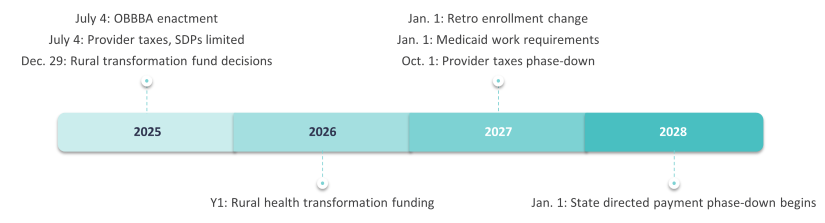
HR 1 contains hundreds of policy changes all with varying effective dates. Here are a few key dates to remember:
The Coming Decade: HCLS Navigate Demographic, Economic, and Tech Shifts
OBBBA’s impact will be felt over the coming 10 years. Learn more about the forces defining the next decade and what you can do to prepare.
- Medicaid provider taxes — Frozen on July 4, 2025, begin to phase down federal fiscal year (FFY) 2028, Oct. 1, 2027
- Medicaid state-directed payments (SDPs) — Capped July 4, 2025, begin to phase down January 1, 2028
- Medicaid work requirements — Begin January 1, 2027
- Medicaid retroactive coverage changes — Begin January 1, 2027
- Rural Health Transformation Fund (RHTF) — Decisions on December 29, 2025, first distributions in 2026
- Tax policies — Varied
Provider tax, SDP policies: State details matter
OBBBA implements sweeping reforms in Medicaid financing and administration. Two principal areas of change involve states’ use of provider taxes and state directed payment mechanisms.
Both are typically leveraged by states to finance part of their share of Medicaid costs as well as draw down additional federal matching funds. All but one state (Alaska) use provider taxes, and roughly two-thirds of states employ SDPs in some capacity.
Provider taxes
OBBBA freezes existing provider taxes, prohibits new taxes, and tightens requirements for taxing methodologies.
In Medicaid expansion states, provider tax rates will phase down from 6.0% to 3.5% over five years, except for nursing homes and intermediate care facilities, which are exempt from the phase-down. Provider taxes begin to phase down October 1, 2027 (FFY 2028).
State-directed payments
SDPs are capped under OBBBA — limited to 100% of Medicare payment rates in expansion states and 110% in non-expansion states. SDPs begin to phase down to these levels January 1, 2028.
| ACA Expansion State | ACA Non-Expansion State | |
|---|---|---|
| State | All others | AL, FL, GA, KS, MS, SC, TN, TX, WI, WY |
| OBBBA Provider Tax Policy |
|
|
| OBBBA State Directed Payment Policy |
|
|
While the Centers for Medicare & Medicaid Services (CMS) released preliminary guidance in late 2025 (see Provider Tax, See SDP) to states, there are unresolved questions.
Additional Medicaid coverage changes
RHTF Applications: 5 Cross-Cutting Themes
- Technology — Addressing cybersecurity, remote care, telehealth, EHRs, interoperability
- Workforce development — Recruiting and retaining workforce, expanded pipelines, rural residencies and rotations, emergency services
- Chronic disease management, prevention — Promoting disease management, wellness
- Maternal health care — Improving maternal and perinatal care, remote fetal monitoring, digital obstetrics, regionalized work
- Sustainable, innovative care models —Creating hub-and-spoke models, shared-service networks, value-based payment reforms
Other interesting uses include “treat-in-place” EMS, drone delivery and remote pharmacy dispensing, strengthening post-acute partnerships, and food-as-medicine. A new office of rural health transformation will oversee the RHTF.
Two additional Medicaid policies of interest are retroactive coverage and work requirements. For retroactive Medicaid coverage, the allowable period is reduced from 90 days to either 60 for traditional enrollees or 30 for expansion population enrollees, effective January 1, 2027.
On work requirements, there are newly established “community engagement” requirements mandating able-bodied adults in expansion states participate in at least 80 hours per month of work, volunteer service, or educational activities. Certain exemptions apply. Effective January 1, 2027.
Rural Health Transformation Fund
In response to anticipated challenges for rural providers, OBBBA establishes a $50 billion Rural Health Transformation Fund (RHTF), allocating $10 billion to states annually from 2026 through 2030. Five billion will go to states equally each year with the remaining five billion based on rurality metrics and individual state applications.
Funds will flow from the federal government to states. States will determine how those funds then flow to providers and others.
RHTF funding decisions were announced December 29, 2025. Each state received varying funding levels, ranging from $147 million to $281 million. CMS released abstracts for all 50 state applications.
Tax, credit policies to consider
One of the main primary reasons for OBBBA was tax policy changes. HCLS businesses or individuals may want to consider:
Research and development credits (Section 174)
Nuanced tax, business, and even estate planning are necessary considerations with any tax-related change. Contact your CLA advisor for assistance.
The R&D tax credit and deduction removes the previous five-year capitalization and amortization requirements for domestic R&D and allows R&D to be fully expensed in the year incurred. Businesses now have a few options on how to treat previous 174 expenses amortized over five years, which could include fully expensing all unamortized five-year costs.
Business interest expense (Section 163(j)
Provides a more generous business interest expense deduction compared to prior law.
Generally, businesses are allowed to deduct interest up to 30% of adjusted taxable income prior to OBBBA. Adjusted taxable income is now computed prior to deducting depreciation and amortization so a higher deduction of interest expense is permitted.
Bonus depreciation (Section 179)
Permanently restores 100% bonus depreciation for qualifying property placed in service after January 19, 2025.
Expensing limits are also increased to $2.5 million with a phaseout threshold beginning at $4 million. (Please note: Careful tax planning consideration is needed for assets that were under contract or binding purchase agreement prior to January 20, 2025, but placed in service after.)
Qualified business income deduction (Section 199A)
Makes permanent the 20% QBI deduction for certain pass-through entities and self-employed individuals.
Some industries (including health care) are excluded from this deduction for higher income earners. For some businesses, determining if you are in the field of “health” according to the tax code isn’t easy.
Executive compensation (exempt entities)
Tax-exempt organizations face an expanded definition of “covered employees” under the 21% excise tax on excess executive compensation.
Prohibition on taxing overtime, tips
Provides individual deductions for overtime and tips. Employers are responsible for tracking these amounts for their employees.
5 recommendations for responding to OBBBA impact
As you plan your next steps and OBBBA implementation evolves, consider these five actions steps:
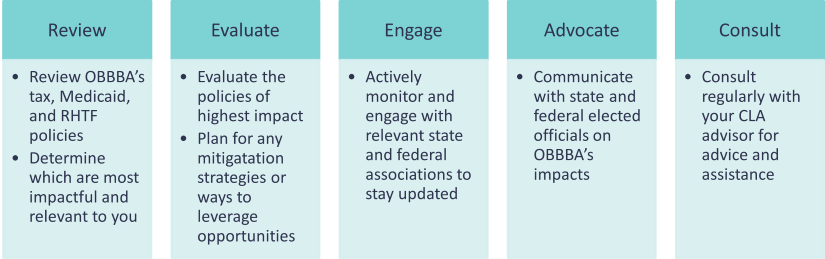
With $1.2 trillion in reduced health care funding over the decade, each state faces varying OBBBA impacts. States could look to reduce Medicaid reimbursements or coverage to address funding shortfalls. As states work to address budget shortfalls, advocacy with state elected officials helps them understand how those decisions impact you.
At the federal level, your advocacy can help elected officials learn how OBBBA’s implementation is affecting you, your patients, and communities since any changes to the law must come from Congress.
How CLA can help you balance health care reform
For organizations or individuals seeking guidance on OBBBA’s impacts, CLA offers comprehensive support, tools, and education. From financial modeling, strategic planning, reimbursement services, or tax-related insights, reach out today.
Contact us
Start shaping your approach to upcoming health policy changes. Complete the form below to connect with CLA.