
Key insights
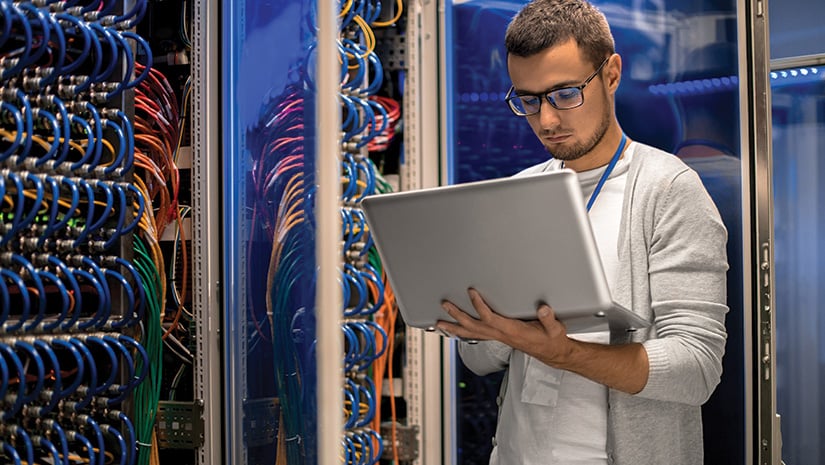
- Data centers are proliferating across the United States to keep up with the massive computing needs of artificial intelligence and cloud-based services.
- These facilities are highly distinctive in their construction, operation, and energy demands, all of which translate to large capital and operating expenses.
- Careful tax planning strategies can greatly benefit data center operators and increase cash flow.
Act now to take advantage of tax credits for your data center.
Data centers are rapidly expanding to meet the massive computing needs of artificial intelligence and cloud-based services. With this growth comes significant capital investment and energy consumption.
Fortunately, U.S. tax policy offers key incentives data center operators can leverage to reduce costs and enhance cash flow while improving their energy consumption strategy.
Renewable energy credits for data centers
The investment tax credit
An increasing number of data centers are looking to renewable energy technologies such as solar and battery storage to supplement traditional grid-based sources. These systems not only support the growing energy demands of data centers — they also provide substantial tax savings through federal credits.
For decades, the investment tax credit (ITC) has served as a powerful tax incentive for organizations installing various types of renewable energy systems. The list of eligible technologies and the amount of the ITC were greatly expanded with the Inflation Reduction Act (IRA), with many systems qualifying for a minimum credit of 30% of their cost. Investments eligible for the ITC include solar, battery storage, fuel cells, and geothermal HVAC — all of which can reduce grid reliance, costs, and carbon output — providing an all-around win for data center operators.
What’s more, data centers that can’t use their federal energy credits due to net operating losses can sell them for cash under the IRA’s transferability option, which has created a robust market for credit buyers and sellers.
Solar
Whether ground- or roof-mounted, solar installations have become common investments for businesses thanks to technology gains and improved project economics through tax incentives.
The One Big Beautiful Bill Act (OBBBA), however, enacted rollbacks impacting the solar ITC, including an accelerated termination date of December 31, 2027 for certain projects and more stringent beginning-of-construction rules. Despite the changes, solar projects remain attractive investments, but could be up against a running clock. As such, now is the time for data centers to explore how solar can enhance operations and cash flow.
Energy storage
The IRA placed a major emphasis on energy storage investments like battery and thermal systems. Batteries can be incorporated into data centers on a standalone basis to store grid-based electricity or by being integrated with photovoltaic arrays to store solar-generated power. In both cases, they can play a major role in energy peak shaving and back-up generation while supporting sustainability goals.
Fuel cells
Fuel cells generate electricity through a chemical reaction, often by combining hydrogen and oxygen. As a secondary energy source at data centers, they can be used for backup power or during high peak times. Fuel cells can further integrate with combined heat and power systems and storage technology to create a microgrid environment, allowing data centers to operate independently from the main grid during outages or peak demand. With a boost under the IRA, fuel cells can generate significant ITCs, often at a rate of 30% or higher.
Geothermal cooling
Geothermal cooling is a highly energy-efficient option for absorbing the large amount of heat data centers generate. It leverages the stable temperatures found underground to help regulate the temperature of the facility and serve chilled water needs for industrial processes. Geothermal heat pump systems provide a reliable, year-round heat sink (or source), reducing reliance on traditional HVAC systems.
The ITC for geothermal can be quite generous thanks in part to the extensive list of system components that can be used toward the credit. With a comprehensive geothermal ITC analysis, nearly the entirety of a facility’s heating and cooling systems can be claimed in some circumstances.
How do cost segregation and bonus depreciation apply for data centers?
A cost segregation study is a tax strategy used by property owners to increase cash flow by accelerating depreciation deductions. This is done by segregating building assets — which are generally depreciated over 39 years — into shorter-lived assets that may qualify for faster depreciation periods of 5, 7, or 15 years.
These shorter-lived assets are also generally eligible for bonus depreciation, which was restored to 100% and made permanent under the OBBBA for property acquired and placed in service after January 19, 2025.
Below are common data center assets that can often qualify for shorter tax lives and full expensing with bonus depreciation:
- Servers and racking
- Networking equipment (e.g., routers, switches)
- Electrical dedicated to processing/computing assets
- Dedicated cooling equipment and piping
- Certain renewable energy assets and improvements
How can the section 179D deduction impact data centers?
Often overlooked by data centers, Section 179D is a deduction available for energy efficient commercial buildings that can exceed $5 per square foot. The deduction specifically applies to certain energy-related components like interior lighting, HVAC, and a building’s envelope (e.g., insulation, windows, roofing). For a building to qualify, it must meet certain energy efficiency requirements and be certified by a properly credentialed energy professional.
For building owners that missed claiming the Section 179D deduction when their qualifying building was placed in service, the deduction can be claimed in a subsequent year without having to amend tax returns. This is done by filing an accounting method change on IRS Form 3115 to “catch up” the missed deductions. (The Form 3115 process is also available for depreciation changes resulting from a cost segregation study).
Section 179D, when combined with a cost segregation and bonus depreciation, can result in immediate expensing of the majority of a data center’s structural and non-structural assets. Companies, however, need to evaluate Section 179D now because the OBBBA accelerated its termination date to June 30, 2026 for property that has not begun construction on or before such date.
How CLA can help with tax incentives for data centers
CLA serves data center operators with an integrated approach, combining our deep cost segregation experience with our clean energy tax advisory practice. Our team of tax professionals and engineers can help your organization identify, capture, and document your fixed asset and renewable energy tax incentives.
Contact us
Contact CLA to discuss how we can help develop and guide your data center’s tax strategy. Complete the form below to connect with CLA.