

By understanding the strengths of each approach, nonprofits can design Sage Intacct to be better aligned with their operations.
Many nonprofits assume they need to recreate their legacy fund structure when moving to Sage Intacct. But what if the way you have always done it is not the most efficient way forward?
Sage Intacct supports both traditional fund accounting and net asset accounting, giving organizations flexibility in tracking donor restrictions, managing reporting, and maintaining financial visibility. Understanding the differences can help simplify reporting, reduce administrative complexity, and position your nonprofit for future growth.
Explore when each approach makes sense and how Sage Intacct supports both models.
At a glance: What’s the difference?
| Approach | Best fit | Key consideration |
| Traditional fund accounting | Organizations needing true, separate balancing funds. | More setup and maintenance; stronger fit when fund-specific balance sheets are required. |
| Net asset accounting | Organizations tracking donor restrictions through dimensions and GAAP-aligned statements. | Cleaner balance sheet presentation and more flexible reporting across grants, programs, and projects. |
What is traditional fund accounting?
Traditional fund accounting tracks activity through separate self-balancing funds. Each fund maintains its own assets, liabilities, revenues, expenses, and net position.
Traditional fund accounting is typically a good fit when:
- Legal or regulatory requirements require separate balancing funds
- Cash and assets are physically segregated
- Stakeholders expect fund-specific balance sheets
- The organization regularly manages fund-to-fund activity
Setting up fund accounting in Sage Intacct
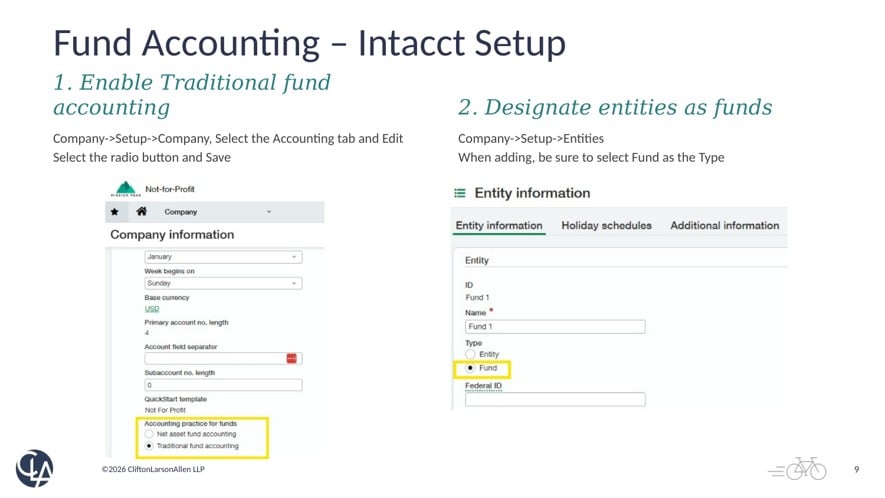
In Sage Intacct, organizations can enable traditional fund accounting and designate entities as funds during setup. Once configured, each fund functions as its own balancing entity.
Managing interfund activity
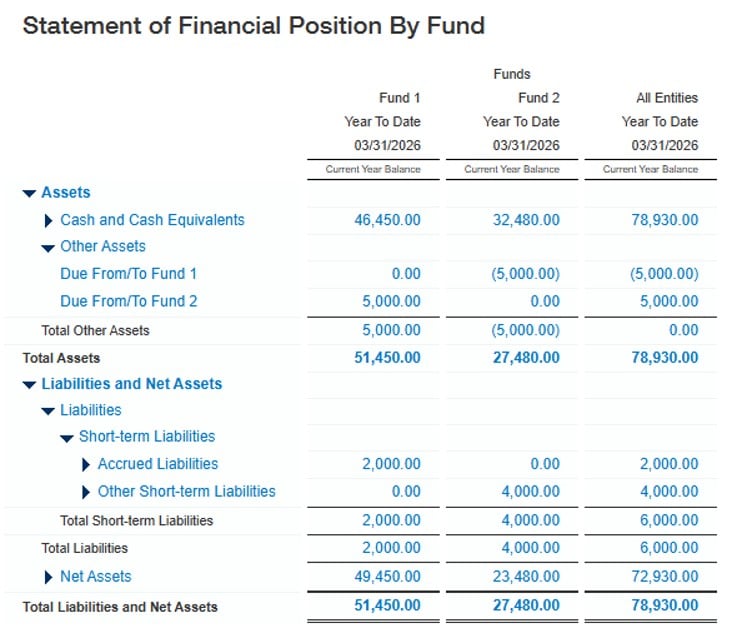
When one fund pays expenses or receives revenue on behalf of another, Sage Intacct can automatically generate the required interfund entries through inter-entity account mapping.
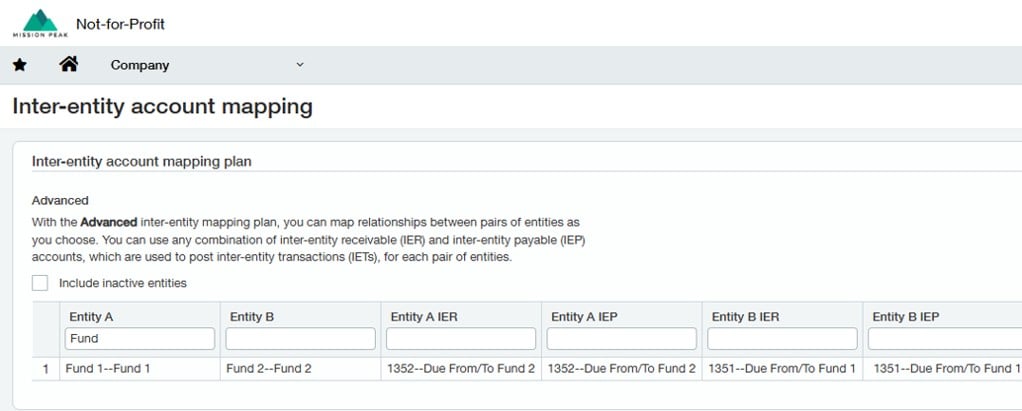
For example, if Fund 1 pays a bill belonging to Fund 2, Sage Intacct can create the balancing journal entries at the time of payment.
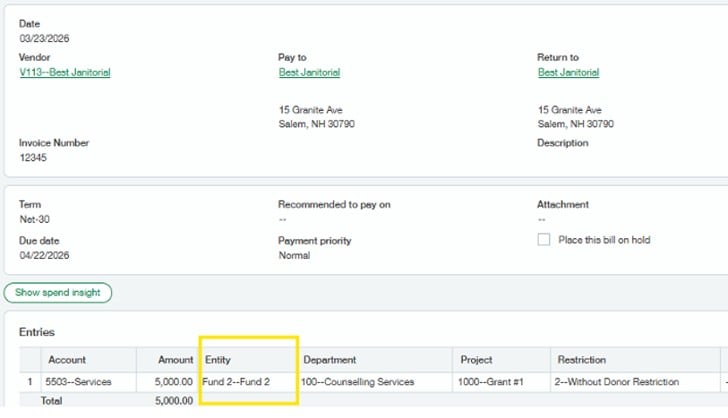
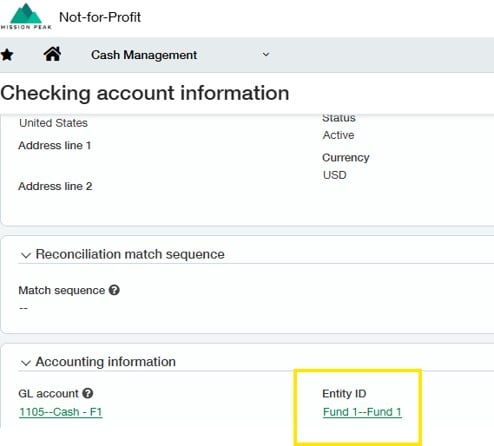
Interfund result: Inter-entity journal posting (second entry) happened automatically at time of payment.
Fund-based reporting
Organizations using traditional fund accounting often rely on fund-specific balance sheet reporting to demonstrate accountability and financial segregation.
What is net asset accounting?
Net asset accounting takes a different approach. Instead of maintaining multiple self-balancing funds, financial activity is tracked at the organization level while donor restrictions are categorized as with donor restrictions or without donor restrictions. Grants, programs, projects, and restrictions are then tracked through Sage Intacct dimensions.
This model can align well with modern nonprofit reporting and often provides greater flexibility for growing organizations.
Why many nonprofits move toward net asset accounting
- Cleaner balance sheet reporting • Easier management of donor restrictions
- More flexibility across grants and programs
- Better scalability as organizational complexity grows
- Strong alignment with GAAP nonprofit financial statements
Setting up restrictions in Sage Intacct
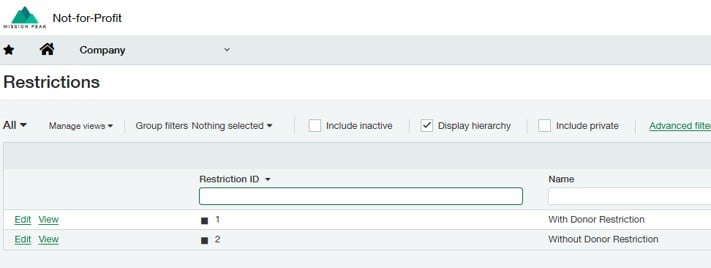
Rather than creating multiple revenue and equity accounts, organizations can create a dedicated Restriction dimension to identify donor-restricted and unrestricted activity. In many cases, the Class dimension may be renamed and used as the Restriction dimension.
Tracking revenue and expenses
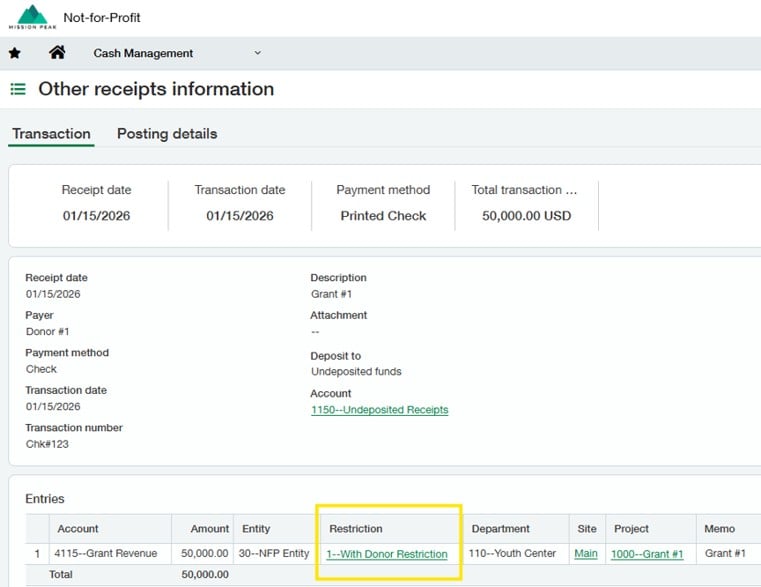
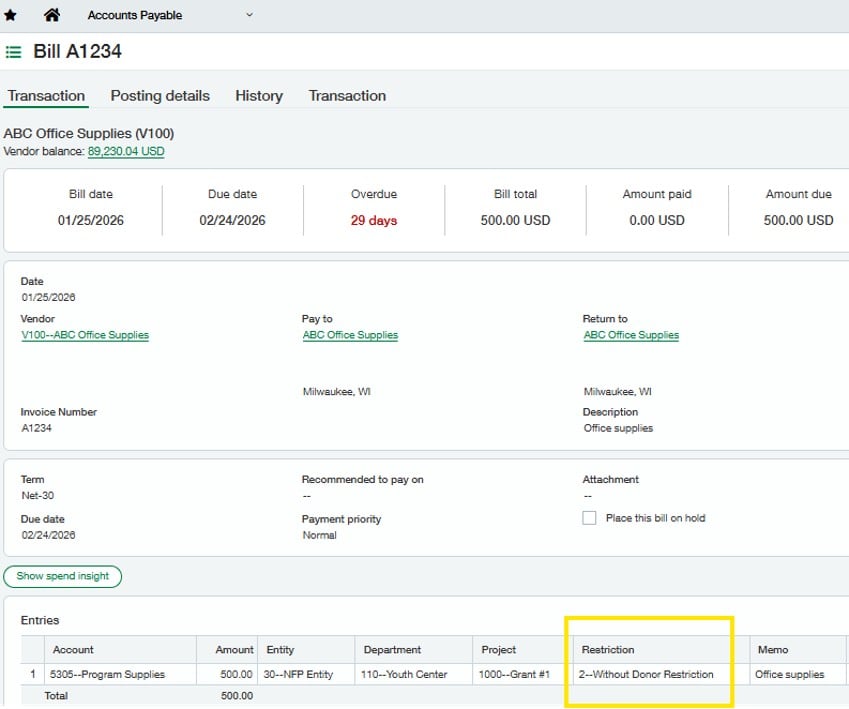
Restricted revenue can be tagged as “with donor restriction,” while expenses associated with the related grant or program can be tagged as “without donor restriction.”
Accounting process: Receipt
Accounting process: Expenses
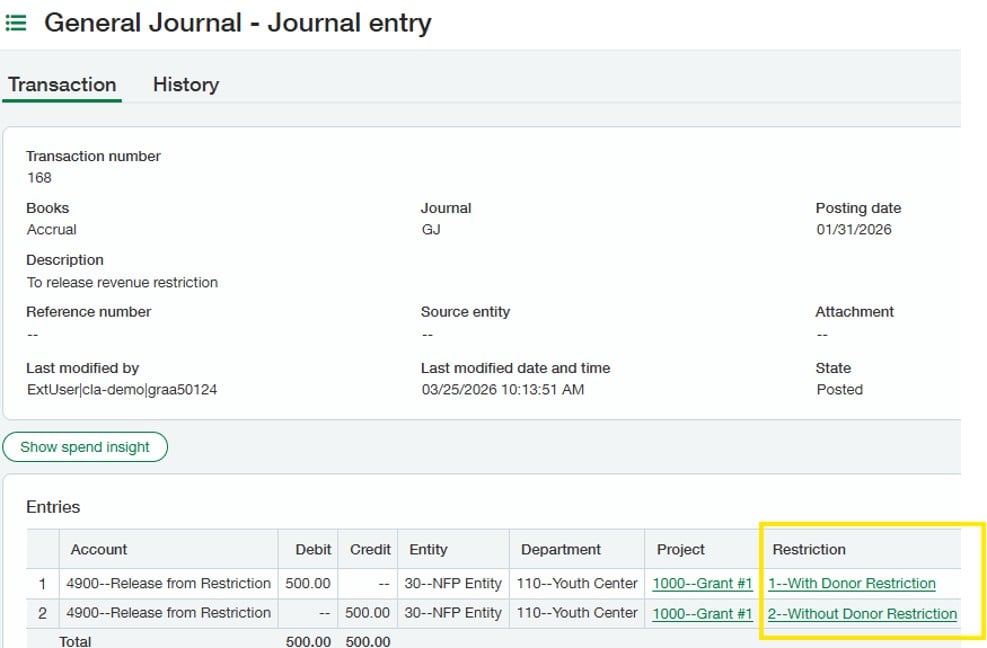
Releasing restrictions
When donor restrictions are satisfied, a journal entry can move activity from “with donor restriction” to “without donor restriction” while maintaining the same grant and account structure. This helps create a clear audit trail and simplifies net asset reporting.
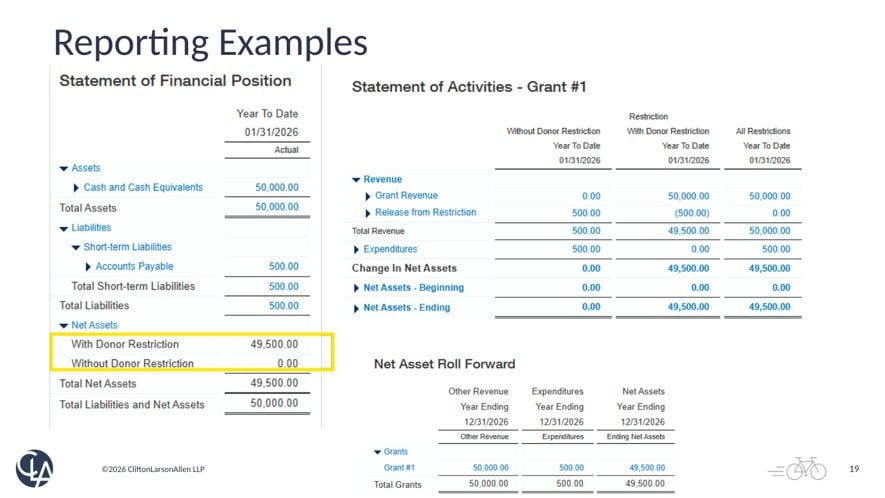
Net asset reporting examples
Sage Intacct can support financial statements, grant reporting, and net asset roll-forward reporting using a dimension-driven net asset accounting approach.
For more details on tracking restrictions and releases in Sage Intacct see this blog series:
- Using Sage Intacct to Track Restricted Net Assets: Part 1
- Sage Intacct for Restricted Net Assets: Part 2 Restriction Release
How CLA can help nonprofits with Sage Intacct
The question isn’t whether traditional fund accounting or net asset accounting is better. The real question is which model supports your organization’s reporting requirements, donor tracking needs, and long-term growth strategy.
By understanding the strengths of each approach, nonprofits can design a Sage Intacct solution that’s easier to maintain, more flexible to report on, and better aligned with the way they operate today.
Whether you are evaluating a Sage Intacct implementation, redesigning your chart of accounts, or determining how to track donor restrictions, CLA can help identify the accounting structure to help meet your organization’s needs and reporting objectives.
Looking for more Sage Intacct resources? Visit the CLA Sage Intacct blog or continue joining CLA’s monthly Sage Intacct webinars for more practical guidance and system design considerations.